ACCESS-ESM
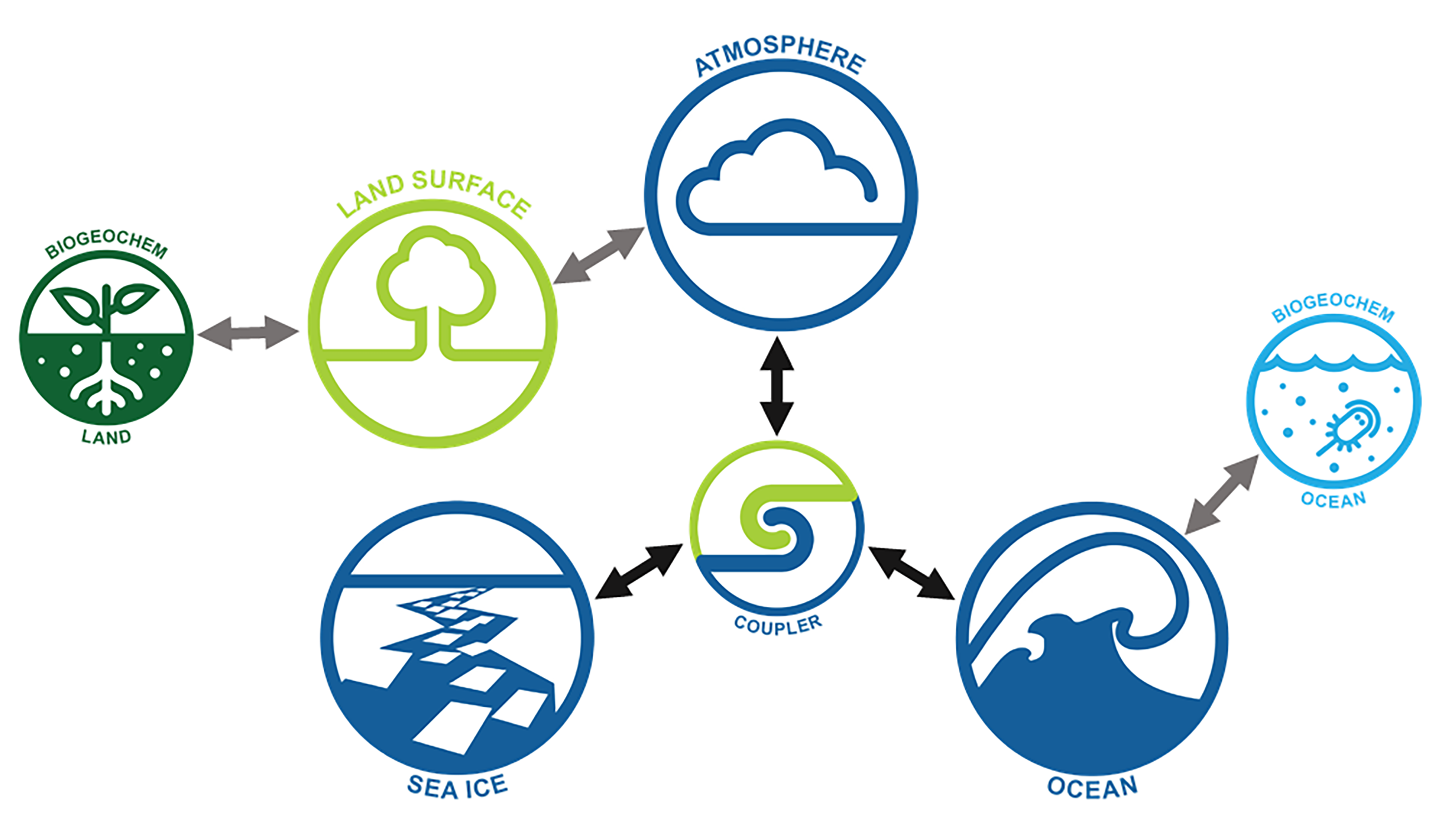
The ACCESS Earth System Model (ACCESS-ESM) is a fully-coupled global climate model that includes atmosphere, land, ocean, sea ice, ocean biogeochemistry and land biogeochemistry components, linked together by a coupler.
This means it can simulate both the physical climate and global biogeochemical cycles, in particular the carbon cycle.
ACCESS-ESM1.6
ACCESS-ESM1.6 is a fully-coupled climate model with land and ocean carbon cycle components. It was developed primarily to enable Australia to participate in the CMIP7 Assessment Fast Track with an ESM version.
ACCESS-ESM1.6 was developed by ACCESS-NRI and CSIRO.
Supported ESM1.6 configurations:
- Concentration-driven pre-industrial control, piControl:
The piControl configuration simulates the climate prior to the industrial revolution using prescribed CO2 concentrations and atmospheric forcings estimated for the year 1850. - Emission-driven pre-industrial control, esm-piControl:
The esm-piControl configuration simulates the climate prior to the industrial revolution using a fully interactive carbon cycle, where three-dimensional CO2 tracers evolve freely in the atmosphere and are exchanged with the land and ocean biogeochemistry submodels. - Concentration-driven historical:
The historical configuration simulates the climate from 1850-2022 using prescribed atmospheric CO2 concentrations and forcings. - Emission-driven historical:
The esm-historical configuration simulates the climate from 1850-2022 using a fully interactive carbon cycle and historical CO2 anthropogenic emissions data.
Details on the forcings and parameters used in the supported configurations are available in the configuration documentation.
Model components
-
Atmosphere: UM7.3, GA7.1 science configuration.
N96 spatial resolution (1.875° x 1.25°), 38 vertical levels. -
Land: CABLE3.
-
Land Biogeochemistry: CASA-CNP.
-
Ocean: MOM5.
Tripolar grid, 1° spatial resolution, 50 vertical levels. -
Ocean Biogeochemistry: WOMBATlite.
-
Sea ice: CICE5.
Same grid as Ocean. -
Coupler: OASIS3-MCT.
ACCESS-ESM1.5
ACCESS-ESM1.5 1 is a fully-coupled climate model with land and ocean carbon cycle components. ACCESS-ESM1.5 was developed primarily to enable Australia to participate in the CMIP6 with an ESM version.
ACCESS-NRI has released ACCESS-ESM1.5 configurations as an adaptation of those originally developed by CSIRO and CLEX CMS.
There are currently two supported configurations:
- Pre-industrial concentration driven:
A global coupled model configuration running in CO2 concentration driven mode under pre-industrial forcings, as described in Ziehn et al. (2020). Pre-industrial forcing data including atmospheric CO2 concentrations are primarily sourced from UKMO versions of CMIP6 inputs, with additional atmospheric forcings sourced from CMIP5 and land cover data adapted from Lawrence et al. (2012). - Historical concentration driven:
A global coupled model configuration running in CO2 concentration driven mode under time varying historical (1850-2014) forcings, as described in Ziehn et al. (2020). Historical forcing data including atmospheric CO2 concentrations are primarily sourced from UKMO versions of CMIP6 inputs, with land use change data adapted from the Land-Use Harmonisation 2 (LUH2) dataset developed for CMIP6 (Hurtt et al. 2017).
Model components
-
Atmosphere: UM7.3, GA7.1 science configuration.
N96 spatial resolution (1.875° x 1.25°), 38 vertical levels. -
Land: CABLE2.4.
-
Land Biogeochemistry: CASA-CNP.
-
Ocean: MOM5.
Tripolar grid, 1° spatial resolution, 50 vertical levels. -
Ocean Biogeochemistry: WOMBAT.
-
Sea ice: CICE4.1.
Same grid as Ocean. -
Coupler: OASIS3-MCT.
ACCESS-ESM1.5 has an equilibrium climate sensitivity of 3.87°C for doubled CO2 concentration.
-
Tilo Ziehn, Matthew A Chamberlain, Rachel M Law, Andrew Lenton, Roger W Bodman, Martin Dix, Lauren Stevens, Ying-Ping Wang, and Jhan Srbinovsky. The Australian Earth System Model: ACCESS-ESM1.5. Journal of Southern Hemisphere Earth Systems Science, 70(1):193–214, 2020. doi:10.1071/ES19035. ↩